

Choosing the right engineering college after 12th grade is a very big decision for many students in India. Two names that always come up are IIT (Indian Institute of Technology) and NIT (National Institute of Technology). Both are top-level institutions, well-known for engineering education. But often, students and parents ask: “Which one is better for me?”
This article from Siksha Saathi will help you understand the differences between IITs and NITs. We will look at many important points like how to get in, the quality of education, campus life, job chances, and more. Our goal is to help you make an informed decision for your Path to Success!
Understanding IITs and NITs: A Quick Look
Before we compare, let’s understand what these institutions are.
What are IITs?
- IITs stand for Indian Institutes of Technology.
- They are Institutes of National Importance. This means they are very important for the country’s development.
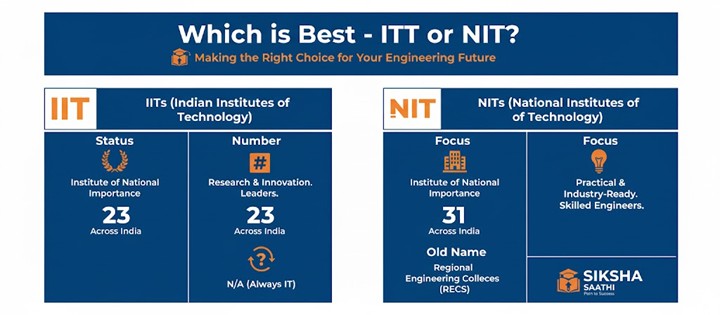
- Number: There are 23 IITs across India (e.g., IIT Bombay, IIT Delhi, IIT Madras, IIT Kanpur, IIT Kharagpur).
- Focus: IITs are known for their strong focus on research, innovation, and advanced technological education. They aim to create leaders and innovators in science and technology.
- History: The first IIT was established in 1951 (IIT Kharagpur). They have a long history of excellence.
What are NITs?
- NITs stand for National Institutes of Technology.
- They are also Institutes of National Importance.
- Number: There are 31 NITs across India (e.g., NIT Warangal, NIT Trichy, NIT Surathkal, NIT Calicut).
- Focus: NITs provide high-quality technical education with a focus on practical applications and making students ready for industries. They aim to produce skilled engineers for various sectors.
- History: NITs were earlier known as Regional Engineering Colleges (RECs) and were upgraded to NITs in the early 2000s.
IIT vs. NIT: A Detailed Comparison
Let’s compare them point-by-point to help you see the differences clearly.
1. Admission Process and Difficulty 📈
This is usually the first big difference students face.
- For IITs:
- You need to clear two very tough exams:
- JEE Main: This is the first step.
- JEE Advanced: Only the top students from JEE Main can appear for JEE Advanced. Getting a good rank in JEE Advanced is the only way to get into an IIT.
- Difficulty: Getting into an IIT is considered extremely difficult due to the very high competition. The number of seats is less compared to the number of students taking the exam.
- You need to clear two very tough exams:
- For NITs:
- You only need to clear JEE Main. Your rank in JEE Main decides if you can get into an NIT.
- Difficulty: While still very competitive, getting into an NIT is generally considered less difficult than getting into an IIT. Many more students get into NITs compared to IITs.
Important point: If your dream is an IIT, you must prepare for JEE Advanced. For NITs, a strong JEE Main score is enough.
2. Quality of Education and Faculty 🧑🏫
Both have excellent education, but there can be some subtle differences.
- For IITs:
- Faculty: IITs have highly qualified faculty members, often with PhDs from top universities around the world. They are known for their research work.
- Curriculum: The courses are designed to be very challenging, focusing on theoretical depth, strong fundamentals, and research. There’s a lot of freedom to choose advanced subjects.
- Research: IITs are leaders in research. Students get many chances to work on research projects, even as undergraduates.
- For NITs:
- Faculty: NITs also have very good and experienced faculty, many with PhDs. They focus on teaching students to be ready for the industry.
- Curriculum: The courses are also very strong, providing a good balance of theory and practical knowledge. The focus is often on industry-relevant skills.
- Practical Learning: NITs often have good labs and industry tie-ups, giving students practical experience.
Important point: IITs generally have a stronger research focus. NITs focuses industry-ready skills. Both offer excellent teaching.
3. Campus Life and Student Culture 🏕️
The environment you study in also matters a lot.
- For IITs:
- Peers: You will be studying with some of the brightest minds in the country. This makes the environment very competitive but also friendly for working together.
- Extra-Curricular Activities: IITs have a very vibrant campus life with many clubs (technical, cultural, sports), fests, and student activities.
- Exposure: Students get exposure to cutting-edge technology, guest lectures from global leaders, and a wide range of academic and non-academic opportunities.
- For NITs:
- Peers: NITs also attract talented students from all over India. The competition is healthy, and students learn a lot from each other.
- Extra-Curricular Activities: NITs also have many clubs, annual fests, and sports events, offering a rich campus life.
- Regional Diversity: Since NITs are spread across different states, you might find a good mix of regional cultures within the student body.
Important point: Both have a very good campus life and students from many backgrounds. IITs usually have a more serious study environment because their entrance exam is very difficult and focused on research.
4. Placements and Job Opportunities 💼
For many students, this is the most important thing.
- For IITs:
- Top Companies: Almost all major national and international companies, especially in core engineering, IT, finance, and consulting, visit IITs for placements.
- Salary Packages: IIT graduates generally get the highest salary packages in campus placements. Many students also opt for higher studies abroad.
- Startups & Entrepreneurship: IITs have a strong culture of entrepreneurship, and many students start their own companies or join early-stage startups.
- For NITs:
- Good Companies: Many top companies also visit NITs for placements, especially Indian companies and IT giants. Core engineering companies also recruit from NITs.
- Salary Packages: NIT graduates also get very good salary packages. While generally lower than IITs, they are still very competitive and among the best in the country.
- Industry Ready: NIT graduates are highly sought after by industries for their practical skills.
Important point: IITs generally offer higher average salary packages and attract a broader range of international firms. NITs provide excellent placement opportunities, especially in diverse Indian industries.
5. Research and Innovation 🔬
If you are interested in a career in research or higher studies, this point is very important.
- For IITs:
- Strong Research Ecosystem: IITs have a very strong focus on fundamental and applied research. They have advanced labs, funding, and PhD programs.
- Publications & Patents: Faculty and students at IITs regularly publish research papers and get patents.
- Higher Studies: A large number of IIT graduates pursue Master’s (M.Tech) and PhD degrees in India or abroad.
- For NITs:
- Growing Research: NITs are also increasing their focus on research and have good M.Tech and PhD programs.
- Industry-Sponsored Projects: Many NITs work on research projects funded by industries, which helps solve real-world problems.
- Higher Studies: Many NIT students also go for higher studies, but the percentage is a little lower than IITs.
Important point: IITs lead in research and innovation. NITs are also growing in this area, often with an industry-oriented approach.
6. Government Funding and Autonomy 💰
- For IITs:
- Funding: IITs receive substantial funding from the central government.
- Autonomy: They have a high degree of academic and administrative autonomy (freedom to make their own rules), which allows them to be flexible with their curriculum and research directions.
- For NITs:
- Funding: NITs also receive significant funding from the central government.
- Autonomy: They also have good autonomy but might have slightly less freedom compared to the older, established IITs in some aspects.
Important point: Both are well-funded by the government and enjoy significant autonomy.
Which One Should You Choose? Making Your Decision 🤔
The “best” choice is not the same for everyone. It depends on your personal goals, interests, and JEE Main/Advanced rank.
Here’s how to think about it:
- If You Aim for Top-Tier Research or Global Recognition:
- IITs are often the first choice. Their strong research focus and global reputation can be a big advantage.
- However, remember that even within IITs, the older ones (like IIT Bombay, Delhi, Madras, Kanpur, Kharagpur) have a stronger reputation than the newer ones.
2. If You Want Excellent Industry-Ready Education and Good Placements:
- NITs are a fantastic option. They provide a robust engineering education that makes you highly employable.
- Also, consider the top NITs (like NIT Trichy, Warangal, Surathkal), which often have placements comparable to some of the newer IITs.
3. Consider Your JEE Rank:
- If you get a very high rank in JEE Advanced, you will have a choice between top IIT branches.
- If your JEE Main rank is good but not enough for IITs, you can get a great branch in a top NIT.
- Sometimes, a good branch in a top NIT (e.g., Computer Science in NIT Trichy) might be better than a less popular branch in a very new or lower-ranked IIT. Always compare specific branches and colleges.
4. Location and Branch Preference:
- Think about the location of the college. Do you want to study near home or in a big city?
- Most importantly, choose a branch that truly interests you. A good branch in an NIT is often better than a branch you don’t like in an IIT, as your interest drives your success.
5. Cost of Education:
- Both IITs and NITs have almost the same fees because the government supports them. They also give many scholarships and financial help to students.
Final Thoughts
Both IITs and NITs are excellent institutions that provide world-class engineering education. There is no single “better” answer for everyone.
- IITs offer a more research-focused and innovation-focused environment, and top branches usually get higher placements.
- NITs offer a more industry-focused, practical-oriented education with very strong placements, especially for core engineering.
Instead of just asking “Which is best?”, ask “Which is best FOR ME?”
Consider your JEE rank, your interest in a specific engineering branch, the college’s location, and its overall reputation for that specific branch. With careful thought and research, you will definitely make the right choice for your successful future.
Siksha Saathi wishes you all the best in your engineering journey!
FAQs❓
1. What is the main difference between an IIT and an NIT?
The main difference is in the focus and entrance exam. IITs (Indian Institutes of Technology) are generally known for a stronger research and innovation culture. To get into an IIT, you must clear JEE Advanced. NITs (National Institutes of Technology) offer high-quality, industry-focused engineering education. To get into an NIT, you only need a good rank in JEE Main. Both are national-level institutes, but IITs typically have a higher global and research-based reputation.
2. Is it true that IIT graduates get higher salaries than NIT graduates?
Generally, yes, the average salary packages offered to graduates from the top IITs are usually higher than those offered at NITs. The best IITs attract top multinational companies, especially in finance and consulting, which offer extremely high packages. However, graduates from the top NITs (like NIT Trichy or NIT Warangal) also get excellent placements with very competitive salaries, often matching or exceeding placements at the newer IITs. So, the difference is mostly seen when comparing the top IITs.
3. If I have to choose between a good branch in an NIT and a lower branch in an IIT, which should I pick?
You should usually choose the branch that interests you more. For example, if you get Computer Science Engineering (CSE) at a top NIT but only Civil Engineering at a new IIT, choosing CSE at the NIT is often better. Your interest in the branch will help you study hard and succeed. Also, the top branches in good NITs often have better placements and facilities than the less popular branches in some of the newer IITs. Always prioritize your passion and branch prospects over just the college name.
4. How many IITs and NITs are there in India?
There are currently 23 IITs in India. These include the older, well-known institutes like IIT Bombay and IIT Delhi, and the newer ones that have been established recently. As for the NITs, there are 31 National Institutes of Technology across the country. Both institutions are spread across various states in India, aiming to provide quality technical education throughout the nation. This large number of institutions provides many opportunities for engineering aspirants.
5. What are the major entrance exams required to get admission to these institutes?
For admission to an IIT, you must successfully clear two exams. The first is JEE Main, and the second is the much tougher JEE Advanced. Only students who score high in JEE Main are eligible to appear for JEE Advanced. For admission to an NIT, only a high rank in JEE Main is required. Admission to both is done through a common counseling process called JoSAA, based on your rank in these specific exams.
6. Are all IITs better than all NITs?
No, this is a common misunderstanding. While the top 5-7 IITs are almost always ranked above all NITs, the top 5-7 NITs (often called the ‘Top Tier’ NITs like Trichy, Surathkal, Warangal) can be better than the newer or lower-ranked IITs. When making a decision, you should compare the specific college, its branch, its location, and its placement record, rather than just choosing a college based on the ‘IIT’ tag alone.
7. Which institutions have better opportunities for research and higher studies?
The IITs generally have stronger opportunities for research and innovation. They have excellent funding, state-of-the-art labs, and faculty members who are deeply involved in advanced research and publications. If your long-term goal is to pursue a PhD or M.S. abroad, the research exposure you get at an IIT can be a significant advantage. While NITs are also improving their research, the research ecosystem and legacy are typically more established at the older IITs.
8. Do NITs have a quota for students from their home state?
Yes, NITs have a Home State Quota. This is a major advantage for students applying to the NIT located in their state. About 50% of the seats in every NIT are reserved for students who have completed their 12th grade from that particular state. This means that if you are applying to your Home State NIT, the required rank for admission will be lower than the rank required for students from other states (the All India Quota).
9. Which institutions are older and have more established alumni networks?
The IITs have a longer history of excellence. The first IIT (IIT Kharagpur) was established in 1951. Because they have been around longer and have a more exclusive entry mechanism, they generally have a more powerful and globally spread out alumni network. The NITs were mostly upgraded from Regional Engineering Colleges (RECs) in the early 2000s, so their collective branding as ‘NITs’ is newer, though their individual histories are also long.
10. Does studying in an IIT or NIT help if I plan to start my own business (Startup)?
Yes, both institutions are very helpful, but IITs have a small advantage in the startup culture. IITs have strong incubation centers and many famous alumni who have started successful companies. Because of this, students at IITs can find funding, mentors, and co-founders more easily. However, many successful startups have also come from NITs. In the end, the success of a startup depends on your idea and your hard work. Still, the network and facilities at both IITs and NITs are very helpful.