

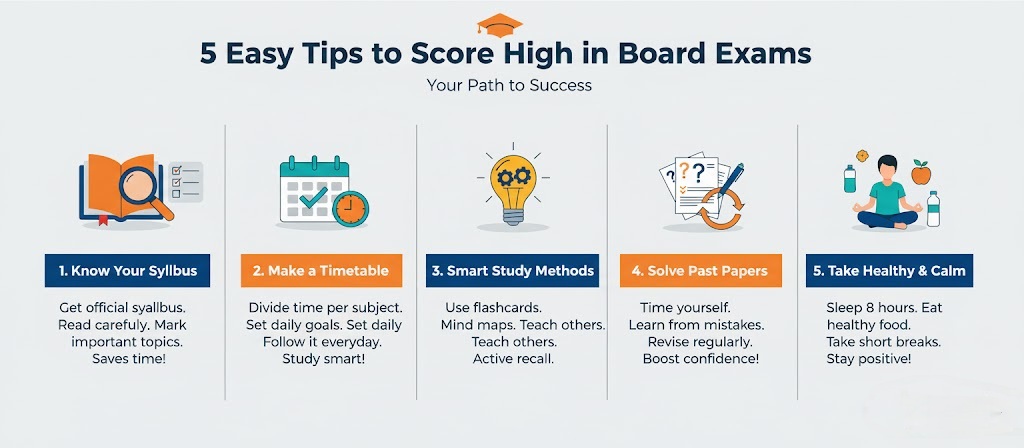
Board exams are very important for every student. They open doors to new colleges and new career paths. Many students feel worried or stressed about these exams. But don’t worry! With the right plan and smart study habits, you can score very high.
This article from Siksha Saathi will give you 5 easy and effective tips to help you prepare well and get excellent marks in your board exams. These tips are simple to understand and easy to follow. Let’s start your journey to success!
Tip 1: Understand Your Syllabus and Exam Pattern First 📚
Before you start studying anything, it’s super important to know what you need to study and how the exam will be. Think of it like a game: you need to know the rules before you play!
- Know Your Syllabus Well
Your syllabus is like a map. It tells you all the chapters and topics that will come in your exam.
- What to do:
- Get the Official Syllabus: Download the latest syllabus for all your subjects (Maths, Science, Social Science, English, Hindi, etc.) from your board’s official website (CBSE, ICSE, State Boards).
- Read it Carefully: Go through each subject’s syllabus. See which chapters are there and what topics are under each chapter.
- Mark Important Topics: Sometimes, your teachers might tell you which topics are more important or carry more marks. Make a note of them.
- Why this is important:
- No Wasted Time: You will not study things that are not in the syllabus. This saves a lot of your valuable time.
- Full Coverage: You will make sure you cover all the topics that will come in the exam. You won’t miss anything important.
- Clear Mind: Knowing your syllabus gives you a clear idea of your study goals.
For Example: For Science, check if “Periodic Classification of Elements” is a full chapter or if only certain parts are included.
- Understand the Exam Pattern
Knowing the exam pattern means understanding how the question paper will look.
- What to do:
- Check Mark Distribution: See how many marks are for each chapter or topic. For example, some chapters in Maths might carry 8 marks, while others carry 3 marks.
- Type of Questions: What kind of questions come in the exam? Are there Multiple Choice Questions (MCQs), very short answer questions, short answer questions, or long answer questions?
- Internal Choices: Do you get choices in questions? For example, “Answer any 3 out of 5 questions.” Knowing this helps you plan your answer strategy.
- Time Limit: How much time do you have for each paper (e.g., 3 hours)? This is very important for practicing.
- Why this is important:
- Prioritize Chapters: You can give more time to chapters that have higher marks.
- Practice Right: You will practice answering the types of questions that actually come in the exam.
- Time Management: Knowing the time limit helps you practice finishing the paper on time.
For Example: If you know there are always 5-mark long answer questions from a particular chapter in History, you will prepare that chapter in more detail.
Tip 2: Create a Realistic Study Timetable and Follow It ⏰
A timetable is your daily plan. It helps you organize your study time, cover all subjects, and avoid last-minute stress. But remember, a timetable should be realistic – something you can actually follow.
- How to Make a Good Timetable
- What to do:
- Divide Your Day: Look at your day. How much time do you have after school, coaching, eating, and relaxing?
- Allocate Time for Each Subject: Give time to all subjects. Give more time to subjects you find difficult or that have a large syllabus.
- Example: If Math is hard for you, give it 1.5 hours daily. If English is easy, give it 45 minutes.
- Include Breaks: Do not study for very long periods without breaks. Take 10-15 minute breaks after every 1-1.5 hours of study. This helps your brain relax.
- Add Revision Time: Always keep some time for revising what you studied earlier.
- Schedule Sleep: Make sure you get 7-8 hours of sleep. This is very important for memory and concentration.
- Be Flexible: Your timetable is a guide, not a strict rule. If one day you cannot follow it perfectly, don’t get upset. Just try to follow it the next day.
- Why this is important:
- Discipline: It brings discipline to your study routine.
- Completeness: You ensure all subjects are covered regularly, so no subject is left behind.
- Reduces Stress: Knowing what to study and when reduces confusion and stress.
Example Action: Your timetable might look like this:
- 6:00 AM – 7:00 AM: Science
- 7:00 AM – 7:30 AM: Breakfast
- 7:30 AM – 8:30 AM: Maths Practice
- (School/Coaching)
- 6:00 PM – 7:00 PM: Social Science
- 7:00 PM – 7:15 PM: Break
- 7:15 PM – 8:00 PM: English/Hindi
- Stick to Your Timetable
Making a timetable is easy, but following it is the real challenge.
- What to do:
- Set Daily Goals: At the start of each day or week, write down what topics you want to complete.
- Tick Off Completed Tasks: When you finish a topic, tick it off. This gives you a feeling of achievement and keeps you motivated.
- Avoid Distractions: When you are studying, keep your phone away. Turn off social media. Find a quiet place to study.
- Reward Yourself: After achieving your daily or weekly goals, give yourself a small reward (like watching an episode of your favorite show, playing a game for a short time, or eating something you like).
- Why this is important:
- Consistency: Regular study is better than studying for many hours one day and nothing the next.
- Motivation: Seeing your progress keeps you motivated to continue.
Better Habits: It helps you build good study habits that will help you in the future too.
Tip 3: Use Smart Study Methods and Active Recall 💡
Just reading your books is not enough. You need to use smart techniques that help your brain remember things better and for longer. This is called “Active Learning.”
- Focus on Understanding, Not Just Memorizing
- What to do:
- Ask “Why?”: When you learn a new concept, ask yourself “why” it is like that. Try to understand the logic.
- Connect Ideas: Try to connect new information with something you already know. This creates a stronger memory.
- Make Notes in Your Own Words: After reading a topic, try to write down the main points in your own simple language. This shows you have understood it.
- Mind Maps & Flowcharts: For complex topics, draw mind maps or flowcharts. They make information easy to see and remember.
- Mind Map Example: For a chapter on “Human Digestive System,” draw a central circle “Digestion” and branch out to “Mouth,” “Stomach,” “Intestines,” etc., with key points for each.
- Why this is important:
- Long-Term Memory: When you understand something, you remember it for a long time. If you just memorize, you might forget it quickly.
- Answer Better: In the exam, if you understand the topic, you can answer questions even if they are asked in a slightly different way.
- Reduces Rote Learning: Less need to just mug up (cram) information without understanding.
- Practice Active Recall and Teach Others
Active recall means testing yourself, not just reading. Teaching others also helps you learn better.
- What to do:
- Self-Quizzing: After studying a chapter, close your book. Try to recall all the main points. Ask yourself questions like “What are the causes of X?” or “Explain the process of Y.”
- Flashcards: Make flashcards. Write a question on one side and the answer on the other. Test yourself regularly.
- Teach a Friend/Family Member: Explain a topic to someone else (your friend, parent, or even a teddy bear!). When you teach, you organize the information in your mind, and you find out what parts you don’t understand well.
- Summarize Aloud: After reading a paragraph, close your eyes and try to explain it loudly to yourself in simple terms.
- Why this is important:
- Strengthens Memory: Active recall forces your brain to retrieve information, making the memory stronger.
- Identifies Weaknesses: You quickly find out which topics you need to revise more.
- Boosts Confidence: Successfully recalling information builds your confidence.
For Example: For a History chapter, after reading about a war, close your book and list the causes, main events, and results in your notebook without looking. Then check your book.
Tip 4: Solve Previous Year Question Papers and Mock Tests 📝
This is one of the most powerful tips! Solving old papers is like doing a rehearsal before the big show (your exam).
- Get Familiar with the Real Exam
- What to do:
- Collect Past Papers: Get question papers from the last 5-10 years for all your subjects. You can find these online on your board’s website or buy them from book stores.
- Treat it as a Real Exam: Sit in a quiet room. Keep a clock. Do not look at books or notes. Write the answers just like you would in the real exam.
- Time Yourself: Finish the paper within the given time limit (e.g., 3 hours). This is crucial!
- Why this is important:
- Understand Question Styles: You will see the types of questions that frequently come and how they are asked.
- Identify Important Topics: You will notice that some topics or chapters are asked almost every year. These are high-priority topics.
- Practice Time Management: You learn how to distribute your time among different sections and questions so you don’t run out of time.
For Example: Take a full 3-hour Math paper from last year. Complete it from start to finish without any breaks, just like the actual exam.
- Analyze Your Mistakes and Learn
Just solving papers is not enough. The real learning happens when you check your answers.
- What to do:
- Check Answers: After finishing a paper, check your answers using the marking scheme or solutions.
- Mark Mistakes: Highlight or circle all the questions you answered incorrectly or couldn’t answer.
- Understand Why You Made Mistakes: Was it a silly mistake? Did you not know the concept? Did you misread the question?
- Revise Weak Areas: Go back to your books and notes. Study the topics where you made mistakes again. Practice similar questions.
- Maintain an “Error Log”: Keep a notebook where you write down your mistakes and the correct solutions for tricky questions. Review this log regularly.
- Why this is important:
- Turn Weaknesses into Strengths: By fixing your mistakes, you improve in your weak areas.
- Avoid Repeating Mistakes: You learn not to make the same errors in the actual exam.
- Boost Confidence: As you make fewer mistakes, your confidence grows.
For Example: If you made a mistake in a Physics numerical question, revise that particular formula or concept, and solve 2-3 more similar problems.
Tip 5: Take Care of Your Health and Stay Calm 🧘♂️
Your body and mind are your most important tools for exams. If they are not healthy, your study efforts might not give the best results.
- Eat Healthy Food 🍎
- What to do:
- Balanced Diet: Eat a variety of fruits, vegetables, whole grains, and protein.
- Avoid Junk Food: Too much oily, spicy, or sugary food can make you feel sleepy or unhealthy.
- Drink Water: Stay hydrated! Drink plenty of water throughout the day.
- Don’t Skip Meals: Especially breakfast! It gives you energy for the day.
- Why this is important:
- Energy for Brain: Good food provides energy for your brain to function well and focus.
- Good Health: You will avoid falling sick during exams, which can be a big problem.
- Better Mood: Healthy eating can also improve your mood.
For Example: Instead of a packet of chips, eat an apple or a handful of nuts when you feel hungry while studying.
- Get Enough Sleep 😴
- What to do:
- Sleep 7-8 Hours: Make sure you sleep for at least 7 to 8 hours every night.
- Fixed Sleep Schedule: Try to go to bed and wake up at the same time every day, even on weekends.
- Avoid Late-Night Studying (Close to Exam): Studying all night before an exam is usually not helpful. A fresh mind is better than a tired one filled with too much last-minute information.
- Why this is important:
- Memory Consolidation: Your brain processes and stores information while you sleep. Good sleep helps you remember what you studied.
- Focus and Concentration: A well-rested mind can concentrate much better.
- Reduces Stress: Sleep helps reduce anxiety and stress.
Example Action: If you usually sleep at 12 AM, try to shift it to 10:30 PM or 11 PM during exam time.
- Take Regular Breaks and Relax 🛀
- What to do:
- Short Study Breaks: As mentioned in Tip 2, take 10-15 minute breaks after every 1-1.5 hours of study.
- Relaxing Activities: During breaks, do something relaxing: listen to light music, walk in your garden, talk to family, or do some light stretching.
- Avoid Screen Time during Short Breaks: Try not to check social media or play games during short breaks, as they can tire your eyes and mind more.
- Deep Breathing/Meditation: If you feel stressed, try a few minutes of deep breathing exercises. Inhale slowly, hold, and exhale slowly.
- Why this is important:
- Refreshes Mind: Breaks prevent burnout and keep your mind fresh.
- Reduces Anxiety: Relaxation techniques can significantly lower your stress levels.
- Improves Productivity: A refreshed mind works more efficiently.
For Example: After completing a tough chapter, take a 15-minute break to just look out the window or listen to calming music.
Conclusion: Your Hard Work Will Pay Off! ✨
Scoring high in board exams is definitely possible with smart work, consistent effort, and a positive mindset. Remember, Siksha Saathi is here to guide you on your Path to Success.
Follow these 5 easy tips:
- Understand Your Syllabus and Exam Pattern First.
- Create a Realistic Study Timetable and Follow It.
- Use Smart Study Methods and Active Recall.
- Solve Previous Year Question Papers and Mock Tests.
- Take Care of Your Health and Stay Calm.
Believe in yourself, stay focused, and keep working hard. Good luck with your board exams! You’ve got this!
❓FAQs
1. How important is it to create a study timetable, and should I stick to it strictly?
Creating a study timetable is very important because it brings structure and discipline to your preparation. It ensures you give time to all subjects, especially the difficult ones, and helps you avoid last-minute panic. However, you should not stick to it too strictly. Your timetable should be flexible. If you miss a target one day, don’t worry—just adjust the plan for the next day. The main goal is consistency and covering the entire syllabus on time, not perfect adherence to the clock.
2. When should I start solving previous year question papers and mock tests?
You should start solving previous year papers and mock tests once you have covered about 60-70% of your syllabus. Do not wait until the very end, as solving papers is part of the learning process itself. Initially, you can solve chapter-wise questions. In the last 2-3 months before the exam, you must start attempting full-length mock tests under strict time limits. This practice helps you manage time and find out which topics are asked most often in the real exam.
3. What is 'Active Recall,' and how can I use it effectively while studying?
Active Recall is a smart study method where you force your brain to remember information without looking at your notes. It is much better than just reading the book again and again. To use it effectively, after reading a topic, close your book and try to write down the main points or explain the concept loudly to yourself. You can also use flashcards or self-quizzing. This method strengthens your memory and immediately shows you which parts of the chapter you have forgotten and need to revise.
4. How many hours of sleep are necessary during the board exam preparation phase?
Getting enough sleep is extremely necessary for high scores. You should aim for at least 7 to 8 hours of quality sleep every night. Many students think studying all night helps, but it actually damages your memory and concentration. Your brain processes and stores the information you learned during the day when you sleep. A well-rested mind is much better at solving problems, thinking clearly, and recalling answers during the exam than a tired mind.
5. Should I focus more on my strong subjects or my weak subjects?
You must try to create a balance between both. You should spend more time on your weak subjects to bring them up to a good level and make sure you pass comfortably. However, you should not ignore your strong subjects. You must give them enough time for regular practice and revision to ensure you score near perfect marks in those subjects. High marks in your strong subjects will compensate for any lower marks in your weaker areas, helping you achieve a high overall total.
6. Is it better to study for long hours or study consistently with breaks?
It is definitely much better to study consistently with short, regular breaks. Studying for very long hours (like 4-5 hours straight) makes your mind tired, and your focus goes down, making the study less effective. Instead, try to study in slots of 1 to 1.5 hours, and then take a 10-15 minute break. This refreshes your mind, prevents burnout, and keeps your concentration level high. Consistency is key, not the total number of continuous hours.
7. How can I manage stress and stay calm during the exam period?
Managing stress is crucial for performing well. The best ways to stay calm are to follow your timetable (which reduces panic), get enough sleep, and eat healthy food. During breaks, try simple relaxing activities like listening to music, talking to family, or light exercise. If you feel very stressed, try deep breathing exercises—inhale slowly, hold, and exhale slowly. Remember that preparation is the best stress reliever, so trust your hard work.
8. Why is it important to analyze my mistakes after taking a mock test?
Analyzing your mistakes is the most valuable part of taking a mock test. It is not enough just to finish the paper. When you check your answers, you must find out the reasons for your mistakes. Did you make a silly calculation error? Did you forget a formula? Or did you misunderstand the question? By knowing the ‘why’, you can go back and revise that specific concept. This ensures you do not repeat the same errors in the actual board exam, turning your weaknesses into strengths.
9. Should I make my own notes, or is it okay to use pre-made notes from coaching centers?
Making your own notes is highly recommended because it forces you to process and understand the information. When you write something in your own simple language, your brain remembers it much better than just reading pre-made material. However, you can use pre-made notes as a reference to make sure you haven’t missed any key points or definitions. The best approach is to read the textbook, understand the concepts, and then create a simple, summarized version of the notes in your own hand.
10. How can I use the prescribed NCERT textbooks more effectively for board exams?
For board exams, the NCERT textbooks are the most important resource. You should read them thoroughly and understand every line and example. Do not ignore the blue boxes, activities, or the end-of-chapter exercises, as many board questions come directly from these sections. Use the NCERT books to build a strong foundation, and then use reference books or guides only for extra practice and clarification. Making short notes directly from the NCERT text is a very effective strategy.